

It’s 9:47 p.m., and you open the school portal “just to check one thing.” The page loads and the screen shows a story you’ve read before and know all too well: missing assignments, zeros, late penalties, and a neat trail of teacher emails documenting what your teen has not done.
The emails sting most, especially since you promised yourself you would step back this week. It’s not because you don’t care, but because you’re trying to stop being your neurodivergent son’s academic glue, the one who holds all-things-school together constantly. Enough is enough.
You call your teen over—first and middle name, because…of course. They glance once and give you the line that feels impossible to take at face value: “It’s fine.” A shrug. An eye roll. A sigh. Then the accusation that you’re overreacting.
How Capable Students Get Misread
That reaction is often what scares parents more than the missing work itself. In a parent’s mind, the preventative steps were straightforward: check the portal, make a list, write it down, communicate with the teacher. The solutions feel so obvious—and so available—that the obstacle starts to look like attitude or motivation. And when it looks like attitude, fear shows up fast: What if they truly don’t care? What happens when no one is there to catch them?
Armor, Not Apathy
Whether a student should submit scores depends on several factors. At colleges with admission rates below 10%, submitting strong test scores can offer a modest but meaningful advantage. For highly selective and moderately selective colleges that evaluate applicants holistically, testing is just one part of the decision-making process—helpful, but rarely decisive.
At colleges that admit a high percentage of applicants, test scores carry far less weight. These are the schools most likely to maintain permanent test-optional policies, allowing testing to be truly optional for many students.
The Hidden Curriculum
As a parent, it’s easy to look at the measurable parts of school, like grades, and assume the issue is understanding. But missing assignments and zeros are rarely content problems for neurodivergent students. More often, they reveal the hidden curriculum of school: executive functioning—planning, time management, working memory, self-monitoring, follow-through.
Once you see it this way, your teen’s reaction stops feeling random. When a student repeatedly experiences, I tried and still fell short, the safest move can become emotional distance—not because they don’t care, but because caring starts to cost too much. Armor is a coping strategy, even when it’s aggravating to live with from the outside.
This is where many families get stuck, not because anyone is failing morally, but because the problem presents itself in a way that invites the wrong solution. Parents respond to visible consequences—missing work, late penalties, teacher emails—by adding more structure and oversight. Teens experience that oversight as pressure or control, and they retreat further into detachment. The more they retreat, the more parents feel they have to step in. Everyone is trying to solve the same problem, but the solutions collide.
Over time, the pattern becomes predictable:
shut down → armor → false assumptions → underdeveloped skills → unsatisfying outcomes → repeat
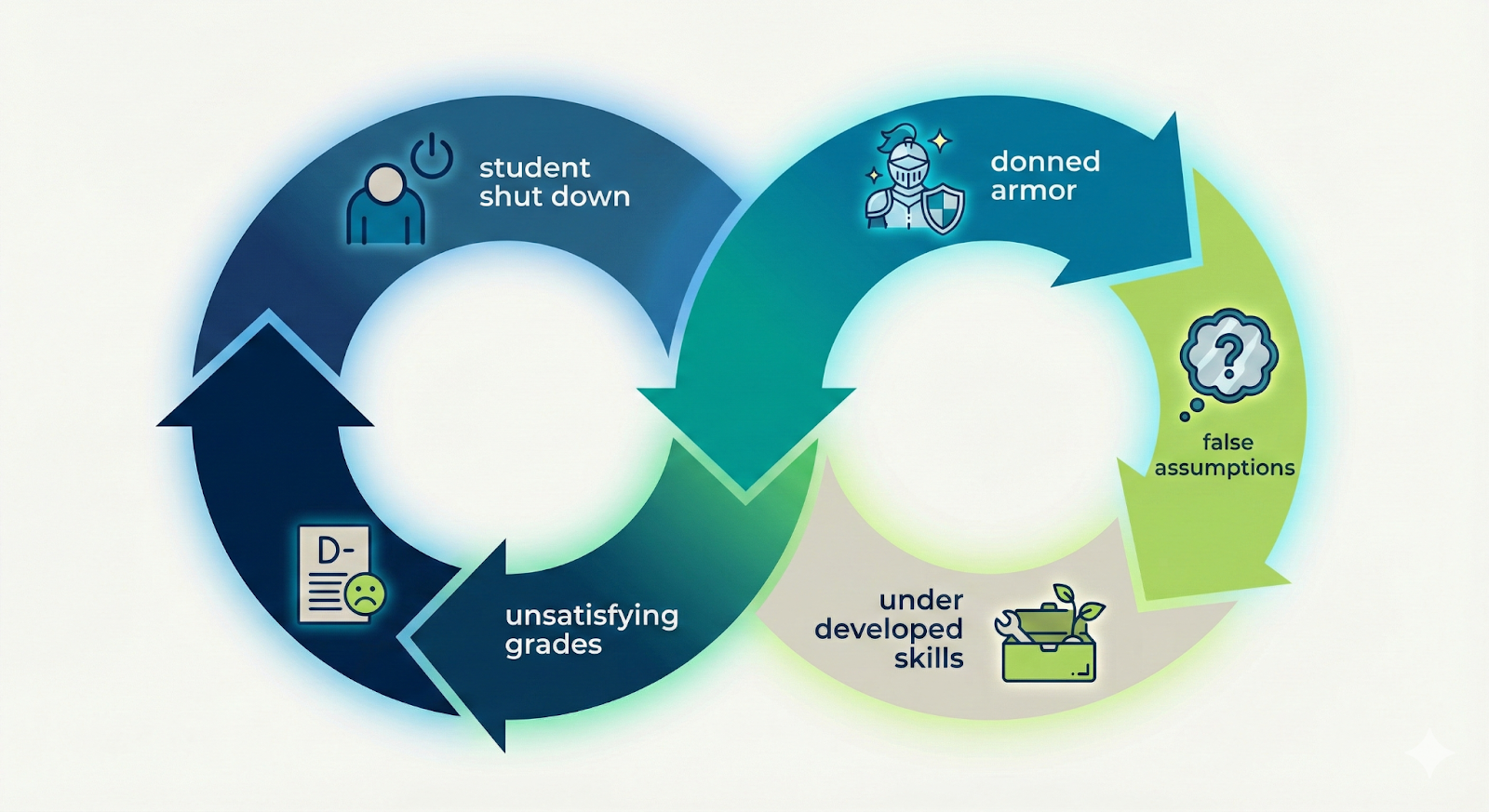 When you can see the loop, you can interrupt it deliberately rather than react to it.
The hardest part is that stepping in often works in the short term. Work gets submitted. The crisis quiets down. The grade stabilizes just enough to let everyone breathe again. But when a parent becomes the system permanently, a teen doesn’t get consistent practice building one. You end up with compliance without ownership, and the same cycle returns the next time pressure rises.
The Scaffolding Principle
Independence doesn’t develop through a dramatic handoff. It develops through a gradual shift in ownership, with support that changes as skill builds. In education and psychology, scaffolding refers to structured support that is intentionally reduced over time as the learner becomes more capable. The point isn’t to remove support; it’s to make support developmental rather than substitutive.
Pull support too quickly and a teen often concludes, I can’t do this. Keep support fixed forever and the conclusion can be just as limiting: I can only do this when someone else runs it. A scaffold sits in the middle. It allows enough wobble for skill-building without turning every mistake into a catastrophe. It also protects something that matters as much as grades: a teen’s belief that they can recover, adjust, and try again without losing face.
This is the distinction most families are reaching for, even if they don’t have language for it yet: support available, not imposed. Available means your teen can reach for support and use it. Not imposed means they still feel the weight of ownership—and therefore the chance to build competence.
What This Looks Like in Practice
Scaffolded independence won’t look identical across families, but the structure tends to hold. The goal is not to overhaul everything at once. The goal is to choose one domain, shift ownership deliberately, and stay there long enough for skill to develop.
Scaffolded Independence Checklist
- Choose one domain only. Pick a single lane—morning routine, homework start time, one test plan, one assignment, one deadline.
- Make the goal concrete. Skip moral language and agree on measurable steps your teen believes are realistic.
- Define support in advance. Decide what help looks like: choosing a system together, a brief check-in, or being available if asked, without hovering.
- Hand off responsibility, not just results. If you’re still tracking, initiating, and managing the timeline, ownership hasn’t actually moved yet.
- Treat missteps as data. A miss is feedback about the system, not a verdict on your teen’s character.
- Debrief without lecturing. What happened? What got in the way? What would you change next time?
- Stay with one domain long enough for momentum. Competence builds confidence; constant switching creates noise.
The goal isn’t to care less; it’s to care in a way that builds capacity. Channel your care into a structure that lets your teen practice ownership long enough to build competence—and the self-trust that follows. For neurodivergent teens, that kind of scaffolded independence isn’t reckless. It is often the most supportive path out of the shutdown–armor loop and into genuine resilience.
If you recognized yourself in this article — the late-night portal checks, the homework battles, the cycle of stepping in just to keep things from falling apart — you're not doing it wrong. You're doing what any invested parent would do.
But there's a more effective way to support a neurodivergent teen. One where you stop being the system — and they start building their own.
At BES, we use a scaffolded coaching model that gives your teen the executive function skills and self-advocacy tools they need to take ownership — while keeping you informed every step of the way.
At Bass Educational Services, we specialize in supporting students who learn differently. Our consultants help families evaluate testing options, secure accommodations, choose the right test, and prepare strategically and always with a strengths-based, student-centered approach.
Contact us to schedule a consultation and learn how we can guide your student toward success.